CTEPH basics
CTEPH, or chronic thromboembolic pulmonary hypertension, is a rare type of pulmonary hypertension (PH).
When people talk about blood pressure, they are normally referring to the blood pressure you measure with a cuff. This is called systemic blood pressure—the pressure in your body’s arteries as your heart pumps blood to the rest of your body. If your systemic blood pressure is high, you have systemic hypertension.
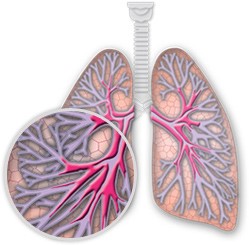
The blood vessels in your lungs, called pulmonary arteries, have their own pressures. In some cases, this pressure can be high, causing pulmonary hypertension (PH). PH makes the right side of your heart work harder. Over time, the right side of your heart becomes enlarged, making it harder to pump blood.
CTEPH is a rare form of PH. In CTEPH, a thrombus (clot-like mass) gets stuck to the lung’s blood vessel wall and blocks blood flow.
Pulmonary thromboendarterectomy (PTE) surgery is a complex surgical procedure performed on eligible people with CTEPH, whose PH is caused by blood clots in the lungs. PTE surgery is used to remove blood clots and restore blood flow to the lungs. This surgery is performed only at select, specialized centers.
Inoperable or recurrent CTEPH
Not everyone is a candidate for pulmonary thromboendarterectomy (PTE) surgery. Your doctor may determine that PTE surgery is not right for you for reasons such as:

The blockages in your pulmonary arteries cannot be reached by the surgeon and are therefore inoperable.

Your CTEPH team has decided, based on your overall health or other conditions, that the risk of surgery is too high.
Even after PTE surgery, you may still experience some symptoms of CTEPH. Also, PTE surgery does not always cure CTEPH. Several studies found that CTEPH came back in approximately 1 out of 10 people who got the procedure. This is known as recurrent CTEPH.
If you are not a candidate for PTE surgery, or you had PTE surgery and your CTEPH came back, talk to your healthcare team about your treatment options.
Treatment
The only FDA-approved medication for CTEPH listed on MedEd Center is Adempas® (riociguat).
Other PAH medications have been used in CTEPH based on smaller trials. Talk with your healthcare team about your treatment options.